On Sunday evening, March 19, 1893, two young people, Rebecca Pines and Samuel Rosenblum, were married at Knights of Piths Hall on Hanover Street. The occasion, probably the first Jewish wedding to take place in Manchester, was marked by nearly half a column in The Manchester Union of the next day. The headlines read, “According to Mosaic Law,” “Interesting Ceremony in the Local Jewish Colony,” and “Wedding Feast and Merry-Making Follow the Nuptials.”
Although there is no indication of the reporter who wrote about the occasion, there were details enough to suggest that the event had stirred more than passing interest. “The Jewish colony in the city was very well represented, and long before the hour set for the ceremony the friends of the happy pair began to arrive at the hall.” The story went on, At 5:30 four of the gentlemen walked to the center of the room bearing a canopy which they there erected. Then Acting Rabbi Axel stepped in front of the canopy and commenced a chant.”
The name of Peter Axel had appeared in the 1892 Manchester City Directory as Rabbi of the Jewish Synagogue at 895 Elm Street, and again the next year when the City Directory placed the Jewish Synagogue on “Central Avenue between Pine and Union.” Rebecca and Samuel Rosenblum, both immigrants to America from eastern Europe, became the parents of four children and established a family that represents the paradigm of the American Jewish experience. Less than twenty years later, their eldest and only daughter; Lillian, entered Radcliffe College. She was not the first Manchester Jewish young woman to matriculate at Harvard’s sister college. Two had preceded her, but she represented the pattern of educational achievement that marked the emerging Jewish community. Two brothers became dentists, one a physician.
When the Rosenblum parents celebrated their wedding day, the Jewish community of Manchester was a little more than a decade old. The first recorded Jewish resident may have been A. Wolf, who is reported to have arrived in Manchester on July 14, 1880. Perhaps there were others before him, but the permanent Jewish community started about 1880. Certainly the need for a place of worship was recognized early, and the first record of an established synagogue was in 1889 at 1058 Elm Street. Then known as “B’nai Jeshurun”, it held services every Saturday from 8 to 10a.m. Officers included Solomon Sullivan, president, and Morris Cohen, vice president. B’naijeshurun was the direct ancestor of Congregation Adath Yeshurun, for the Sullivan and Cohen names appear repeatedly in the early records of the synagogue until well after Adath Yeshurun had been incorporated. “Sullivan” may seem a strange name for a practicing Jew, but the name was one of many similar adaptations to a new country. Solomon Sullivan had been born “Soloveitchik” and had acquired his new name about the time he came to America. Other members of the family changed the name to “Nightingale,” a literal translation from the Russian meaning.
By 1891, Manchester community records listed 21 adult working Jewish men, nine of them heads of families. The synagogue membership was made up of immigrants primarily from Lithuania, known as “Litvacks” with a few from the Ukraine, generally known as the “Russische.” As the congregation grew, so did the differences among its members. While common needs for social relationships drew them together, liturgical differences became dividers. In 1897, the dissenters, the Russische, decided to form their own synagogue and Congregation Anshe Sephard came into being. The firm dating of the second Manchester congregation helps to establish the lineage of Congregation Adath Yeshurun. It is unquestioned that Anshe Sephard represented a dissenting congregation. Long into the first years of the twentieth century the slate of officers of Adath Yeshurun continued to list many of the same names from the earlier; pre-separation period.
This history of the 1890’s, particularly the schism in the congregation, establishes the one hundred years of Adath Yeshurun. Even though the first official mention of the congregation in the Manchester City records is the incorporation of Adath Yeshurun at 197 Central Street on January 4, 1900, the day after its first recorded meeting was held, it is indisputable that the legislation calling for incorporation of religious organizations had only been passed in the I 899 session of the New Hampshire General Court. There was no pressing reason earlier for such formal registration. Land for a cemetery had been purchased on South Beech Street in 1896 and there is ample evidence of congregational activity through the 1890’s. (There are even records of a cemetery site in Bedford before 1896, but that site was abandoned.)
The peripatetic wanderings of the early congregation centered in the same parts of the city of Manchester where most of the early Jewish arrivals lived. Central Street, Pine Street, various locations for the young shul were listed among Manchester records. A report, “Our Progress,” in a celebratory synagogue program book of 1912 recounted the growth of the congregation from its incorporation by 17 members in 1900 when services were held in a single room. In 1902 a cottage was purchased at 94 Laurel Street and subsequently remodeled for the growing congregation, and in 1910, after years of having to obtain rented quarters for High Holy Day services, the small congregation embarked on a campaign for more suitable space. Rosh Hashanah and Yom Kippur services had been held at Knights of Pythias Hall or Odd Fellows Hall, with the lodge decorations removed for the New Year and Atonement services. The arrangement was hardly adequate and on one occasion the congregation was forced to vacate the hall on Yom Kippur to make room for a previously scheduled lodge meeting. That event apparently galvanized the advocates of a new synagogue, and a fund-raising campaign began. Two members of the congregation (unnamed) each pledged one thousand dollars, a ball and bazaar in October 1910 raised another fifteen hundred dollars, and other pledges were collected. Construction started with the laying of the foundation in April 1911.
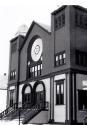
The building on Central Street housed religious services, a one- or two-room cheder (religious school), a kitchen, and a vestry or social hall downstairs. The vestry doubled for services on those many occasions when the congregation was small and money for heating the big upstairs was scarce. A shed-like extension faced the alley behind the building and in time there was even a permanent sukkah alongside the building for the autumn Sukkot festival. That small addition had a hinged roof, which was removed for the harvest festival allowing the rafters to be filled in with evergreen boughs. (The back shed provided a space where the rabbi, who also served as schochet or ritual slaughterer occasionally performed kosher slaughtering of poultry for members of the community who brought their live birds to him for the proper rituals). Upstairs, in the large sanctuary, there was room for perhaps 600 people, and the space was crowded for the high holidays in the fall and occasionally for Shabbat morning bar mitzvahs. In the male preserve on the main floor, pews in a central section and two side sections under the balcony all faced south toward the bi’nah, the raised platform for the reading desk and the ark holding the Torah scrolls. Immediately adjacent to the bimah on either side the pews were faced toward it. The women and young girls sat upstairs in the balcony which surrounded the hall on three sides. The balcony had three rows of seats along the sides facing into the sanctuary and eight or nine rows in the rear.
The first services in the new building, the first specifically built as a synagogue for a Manchester congregation, took place September23, 1911. In March 1912, four days of open house festivities provided for a celebration. A festive program book filled with advertising from members of the community and other well wishers marked the occasion. The Manchester National Bank advertised safe deposit boxes, priced at $1.00 per year and up, and the New Hampshire Fire Insurance Company proclaimed assets of over $5,500,000. A long program on one evening included greetings from dignitaries, both religious and civil, and a list of musical and dramatic performances by members of the community. Several members of the Lowenstam family performed on the piano and violin and Samuel Rosenblum’s nieces, Miss Esther Rosenblum and “Little Miss Flora” Rosenblum each played a piano solo. (Morris Rosenblum, father of the two young piano players, served as president of the congregation in 1916-17, and was recalled years later as a devoted and hard-working synagogue supporter. He had also been instrumental in obtaining the original cemetery site in 1896, when $1,000 was raised to purchase the South Beech Street land. His two daughters became the first Manchester Jewish young women to attend Radcliffe College, slightly before their cousin, Lillian).
The new synagogue, a frame building painted light brown and trimmed in a darker shade, served the congregation for nearly half a century. In the 1930’s there was a major renovation, highlighted by the painting of clouds in a blue sky in the arch above the semi-circular bimah. The bimah had stairs on either side leading up from the men’s pews in front of it and a curved stained wood railing and balustrade. Amber stained-glass windows provided a sense of seclusion in the sanctuary, for the neighboring buildings, especially on the west side of the synagogue, stood close by.
For years it was usual for a boy’s bar mitzvah celebration to take place at Saturday morning Shabbat services. There was a sense of community in the festivities, as the thirteen-year~old participated in the services, read the Torah blessings, and chanted his Haftorah. After the service, family and friends gathered in the vestry below the sanctuary for lunch, usually prepared by the women of the family with help from other members of the congregation. The kosher kitchen adjacent to the vestry was a cheerful place, where many hands made light work and where eagle eyes made sure that no one violated the rules of kashruth. Undoubtedly hired accommodators were used on occasion, but the celebrations had about them a homemade, family feeling.
An awareness of the needs of the less fortunate members of the congregation had early created a special role for the women. The Ladies’ Aid and Benevolent Association of Adath Yeshurun came into being in 1910, eventually becoming the Temple Sisterhood. Women brought their homemak-ing and business skills together into the synagogue structure, organizing fund-raising activities, rummage sales, bazaars and social and cultural affairs. Dozens of women served as leaders over the years. Among them was Sadie Flaxman, daughter of immigrants from eastern Europe, who was born in New York and finished her schooling in Hartford, Connecticut.
Subsequently she became a social worker for the Connecticut Children’s Bureau and, in 1925 came to Manchester as the wife of Samuel Stahl, a local dentist whom she had met at a YM/YWHA con-vention. She embarked on a career of community work. Sisterhood, Hadassah, the Community Center and a variety of non-Jewish organi-zations all benefited from her as-tute grasp of institutions and their community functions. Years later, Jewish women like Ethel Greenspan recalled how Sadie Stahl had introduced them to community responsibilities. Mrs. Greenspan, in turn, filled the leadership role in the synagogue and other community activities. The congregation usually struggled financially, and carrying the mortgage which had been nec-essary to complete the building was a heavy burden. During the twenties and thirties, the congregation was barely able to meet its financial needs. Almost no one in the Jewish community had much money, and the affairs of the congregation reflected its members’ problems. When the first mortgage was finally burned in 1937, the congregation voted never to borrow money for a synagogue building again.
The Jewish community was not different from the general population of Manchester The city suffered from the decline of the Amoskeag Manufacturing Company, and money for any purpose was hard to come by. During those days, two mainstays of Congregation Adath Yeshurun had been Edward M. Chase and Abraham Machinist. Both downtown merchants, they had begun their careers late in the late 19th century and by the time of World War I had become financially successful. The two were undoubtedly the strong-est support of the congregation, and some of their debates became legendary as each strove to pressure the other to increase his donations. On Kol Nidrei night, when the entire congregation gathered at dusk in the Central Street shul, fund-raising was carried on. A non-Jew, Arthur Davis, resident caretaker of the YM/YWHA building on Hanover Street, sat with pencil and pad of paper in the back of the sanctuary and recorded the pledges. As he listened and wrote down the congregation’s promised contributions, Chase and Machinist often challenged each other at those fund-raising sessions.
Chase had come to Manchester in the 1880’s, begun a business, which eventually became a furniture store, and started the real estate holdings that made him a power in the community. He was gifted with imagination and a keen sense of social responsi-bility. Just after the First World War he bought a tract of land on south Maple Street and built a group of small frame bungalows. The houses were sold to working people for minimal down payments and favorable mortgage terms, and by the mid-thirties the experiment had been so successful and so much of the original cost repaid that Chase bought a farm on Mammoth Road in East Manchester and redid the experiment, building a group of brick houses and selling them on similar terms. Both groups of houses still stand today in 1991, testimony to the far-sighted social vision of E.M. Chase.
Machinist, too, had a keen sense of community. From his dry goods store on Hanover Street he reached out to the Jewish and non-Jewish community. In the 1930’s he took on as a special project the unifica-tion of the divided Jewish cemetery for he strenuously objected to the perennial cemetery arguments that had festered between the two congregations since 1918 when Anshe Sephard had bought land adjoining the Adath Yeshurun cemetery for its own use. For years a fence down the middle of the cemetery had separated the land on which the two congregations buried their dead and Abe Machinist worked hard and long to remove that visible sign of dissension. Finally, in the late 1930’s, Machinist negotiated an agreement with
Congregation Anshe Sephard to establish a single cemetery. Abe Machinist donated the gates (he would later finance their restoration in the late 1960’s as well) and he and Nathan Eckman signed an agreement for their respective congregations. Milton Machinist recalls that his father and Eckman marked the occasion by exchanging the fountain pens with which they had signed the document. Abe Machinist emphasized the permanence of the cemetery merger by purchasing burial plots on both sides of the erstwhile dividing line. His action is now memorialized in the broad family…
Temple Adath Yeshurun – Historical Update
November 15, 2025
Dr. Alan D. Kaplan
There is an excellent history of the founding of TAY in 1891 through the Centennial year by Dr. David Stahl published in the Booklet that accompanied the Centennial celebration in 1991. Exerts also appear on the TAY website. Rabbi Arthur Starr served as 1971-(Rabbi Emeritus) became the spiritual leader from 1971- 2002. During his tenure the congregation grew in size and became more involved in the community with Rabbi Starr hosting a weekly TV program. He developed many social programs. He also attempted to build a merger between Temple Israel (Conservative) and TAY though this did not come to fruition. Rabbi Barbara Borts served as an interim Rabbi for two years (2002-2004).
Rabbi Davidson (2004 – present) became our leader in 2004. She became the first woman to serve as a full time congregational rabbi in the state of New Hampshire. She helped the Temple navigate numerous challenges faced by congregations throughout the country including declining religious affiliation, the tragic shooting at the Tree of Life Synagogue in Pittsburgh in 2018, the rise in anti-Semitism and heightened security concerns. She was a steady hand during the Covid-19 pandemic of 2020 and encouraged the use of technology to keep the congregation praying, learning and involved with social programming when they could not gather in person. On May 18, 2024 the congregation celebrated Rabbi Beth Davidson’s 20 years (2004-2024) as TAY’s spiritual.leader. That event planned by past TAY president Dr. Alan D. Kaplan and David Rosenszwig along with the TAY Brotherhood turned the annual Brotherhood Deli-nite into an opportunity to recognize the substantial contributions Beth made to TAY’s mission of worship, education and assembly for the local Jewish community. She was honored with remarks by US Senator Maggie Hassan, Rabbi Jonathan L. Hecht PhD Dean of HUC Cincinnati Campus and a classmate of Beth’s, Allyson Guertin – Executive Director of the Jewish Federation of NH, Erich Ratinoff – President of TAY and Dr. Alan D. Kaplan. A Magic Show by performing artist Andrew Pinard capped the evening only out done by the culinary delights of the three food groups Corn beef, Pastrami and Tongue sliced by our local brisket mohel Steve Short with a side of potato salad by TAY past present Jet Goldberg.
I adopted Dr. Stahl’s historical approach of identifying changes in the spiritual, structural, social and financial events through discussions with or consulting records of those who brought them about. I was able to contact most of the presidents who served during the past 25 years and asked them to identify the highlights of their terms of office.
Barry Scotch 1991-1992 along with Judith Jolton 1992-1994 were instrumental in creating the Centennial celebration. Barry initialed the postage paid return envelopes for dues and donations that helped our bottom line. He was also president when US President George HW Bush who was running for re-election came to Deli-nite to meet members of the Manchester Jewish community. He also welcomed Jessie Jackson the first African American candidate for president and Gabe Pressman – representative from NY to our candidates forum organized every two years by the Brotherhood. Judith tenure was marked by growth in membership peaking at about 400 families. She was also instrumental in pursuing community programs including feeding the hungry and annual food drives for the Manchester shelter and soup kitchen. She has continued to this day to tend to the social needs of our community.
Susan Grodman & Michael Kasten – served as co-presidents 2007-2009. They oversaw growth of the school and outreach to the Manchester Jewish Community.
Jet Goldberg 2009-2011 – oversaw a major transition from a board that had been comprised of long term members who had served repeated terms but were now retiring or moving to be closer to children to a younger board. Based on her background in human relations and social services she addressed and updated personal policies and began work on revising the by-laws.
Bob Katchen 2011-2012 For years Bob has been chairman of the House committee and has maintained the physical structure of the building. In 2011-2012 he set down his hammer and screwdriver long enough to repair some of the unrest regarding transparency of the Board of Directors meetings and decisions and concerns raised by some congregants about the Rabbi. He initiated a member wide survey to address congregational concerns and used the results to initiate a structured performance review for the staff and Rabbi and assure everyone that the board meetings were open to all members of the congregation. He brought in an outside consultant who suggested we change the bylaws to allow two year rather than one year terms for the president for better continuity. He healed internal distrust and set the stage for Lee Hill, the next president to continue evaluating the congregational membership and finances.
Lee Hill 2012-2014 initiated a detailed audit and update of membership records and determined the actual number of members who were in good standing thus reducing the overestimate that was determining our URJ dues responsibility. He established a structured and consistent dues abatement process replacing the arbitrary system. His attention to financial solvency of the Temple resulted in the following:
- A bidding process requiring three bids for the annual cemetery maintenance contract
- Reduction in office expenses and new leases of office machines
- Averted a looming budget deficit through careful expense review and a modest dues increase
- A concise but detailed financial and membership report became part of the monthly BOD meeting.
- All Temple cash operation accounts were verified.
- Successful fundraising with the annual Bagels & Biscuits was established creating ties with the greater Manchester community and raising $20,000
- Succession planning identified the next three presidents ensuring the transition for the next three years.
- A Knosh and Schmooze was added to immediately precede each monthly BOD meeting to create a cohesive team environment and welcome new BOD members.
Dr. Alan D. Kaplan 2014-2016 – Identified the need for structural change of the aging physical condition of the Temple. He initiated a capital campaign that raised just under a half million dollars. The following projects were addressed:
- removal of the pews and replacement with comfortable chairs that could be re-arranged based on programming needs. This flexibility allowed for more intimate settings for small worship services, expanded seating for High Holiday services and semi-circle seating for visual programs with a projection screen.
- Handicap ramp along the northern Sanctuary wall from the floor to the Bimah.
- Re-structure of the Bimah with elevation of the organ pit and a choir area
- Design of a new Ark with stain glass windows and internal LED lighting
- New carpeting in the sanctuary.
- Construction of a new movable wall between the Sanctuary and social hall that could be opened and closed in minutes (the old wall took three men two days). The upper portion consists of multiple clear glass panels that both provided brighter spaces and the opportunity to install video cameras in the future to live stream services and social hall programming to those shut in by illness, weather or distance.
- Expansion and improvement of the audio system for the Sanctuary, social hall and patio and intercom for the school. Addition of wireless mic technology and speakers.
- New LED energy efficient lighting in the Sanctuary and social hall that is individually dimmable.
- Re-furbishing and landscaping of the patio area with creation of an outside handicap ramp.
- Initiated two unofficial board committees: Technology and Safety/ Security to handle our increasing technology needs and evaluate our preparedness for increasing antisemitism.
- Increased Temple participation in the URJ and personally stepped up to the URJ North American Board of Directors
- Served as a Cantorial Soloist and Service leader and choir leader for annual Brotherhood/Sisterhood service
- Negotiated a shared parking arrangement between TAY
Cate Tanzer 2016-2018
- Completed the three year capitol campaign with almost double the initial planned fund raising.
- Developed programs of community outreach
- Promoted fund raising through additional years of Bagels and Biscuits
- Hired professional teachers and a Religious School Director
- Reduced dues for new Temple members and free tuition for first year Hebrew school
- Initiated the initial lease with North End Montessori for use of the classrooms for their pre-school.
Bob Bersak 2018-2020
- Changed the calendar year to January 1st.
- Changed the Safety/security group to an official committee status in view of increasing attacks on Houses of Worship
- Initiated armed guards at the Temple and developed security plans with partners in local law enforcement Manchester Police, FBI and Homeland Security.
- Together with Dr. Alan Kaplan (security chair) applied for and secured the first of what would be three Federal Security grants (each at the maximum level). These grants hardened our facility by controlling access with layered electronic monitored and released entrance systems, installation of bullet proof glass at the entrances, cameras covering the outside of the property, changing classroom glass to non-breakable “school glass”.
- Initiating training sessions for congregants, teachers, administrators and students for emergencies.
- Extensive review and revision of the by-laws.
- Active roll with the Trust committee in Temple finances
Jonathan Baron 2020-2022
- Took us through the Covid years with the need to close the Temple and initiate mask policies
- Together with Technology chair developed multi-camera system for congregation participation in Services, Torah study and social programs via Zoom.
- Upgraded office computer and telephone systems
- Became TAY’s second member of the URJ NorthAmerican Board of Directors
- Cantorial Soloist and service leader
- First openly gay president of the Temple who has made this a welcoming community for everyone with sensitivity regarding Diversity, Equity and Inclusion
Jake Berry 2022-2024
- Guided the Temples return to in person services after Covid
- Policies and guidelines for masking and social distancing
- Two significant flooding issues – negotiations with insurance companies and re-opening closed areas of the building.
- Started Bagel Run as a fund raiser
- Established social programs including movie night, game night and educational programs through life long learning
- Renewed contract with Montessori for lease of the classrooms
Eric Ratinoff 2024 – present
- 20th Celebration/Deli-nite for Rabbi Beth Davidson
- Creation of new Jewish Learning Collective of Manchester, reuniting TAY and Temple Israel in one religious school
- Adoption of “Invite a Friend to High Holy day Services to encourage new members
- Adoption of Terumah, a sustaining membership dues model
- Oversaw the search for a new Rabbi after Beth’s 22 years of service.
Of course the story is not complete without reference to all the work done by many members of Brotherhood under the recent leadership of Saul Rockenmacher, Mark Granoff, Dave Penchansky and Sisterhood under the recent leadership of Linda Rockenmacher, Gail Ellis and Dot Warshaw as well as all those heading up sub-committees of the board as well as the Brotherhood and Sisterhood.
We are a vibrant, healthy congregation growing once again in membership with new and evolving opportunities to worship both in person and remotely, exciting social programming and the chance to learn more about our Jewish history through weekly Torah study, programs. We learn with Israel scholars and communities in Israel via technology connections and local experts on antisemitism and the impact of US and local governance through education programs led by Pat Malick and Marilyn Cavanaugh. We are grateful to the years of dedication and service by Rabbi Beth Davidson and look forward to an exciting future with a new Rabbi who will lead us to preserve Jewish values and lead us in stimulating and exciting spiritual, educational and social opportunities.
If you are interested in knowing more of Our Temple’s History please stop by the Temple and ask for a full copy!
